
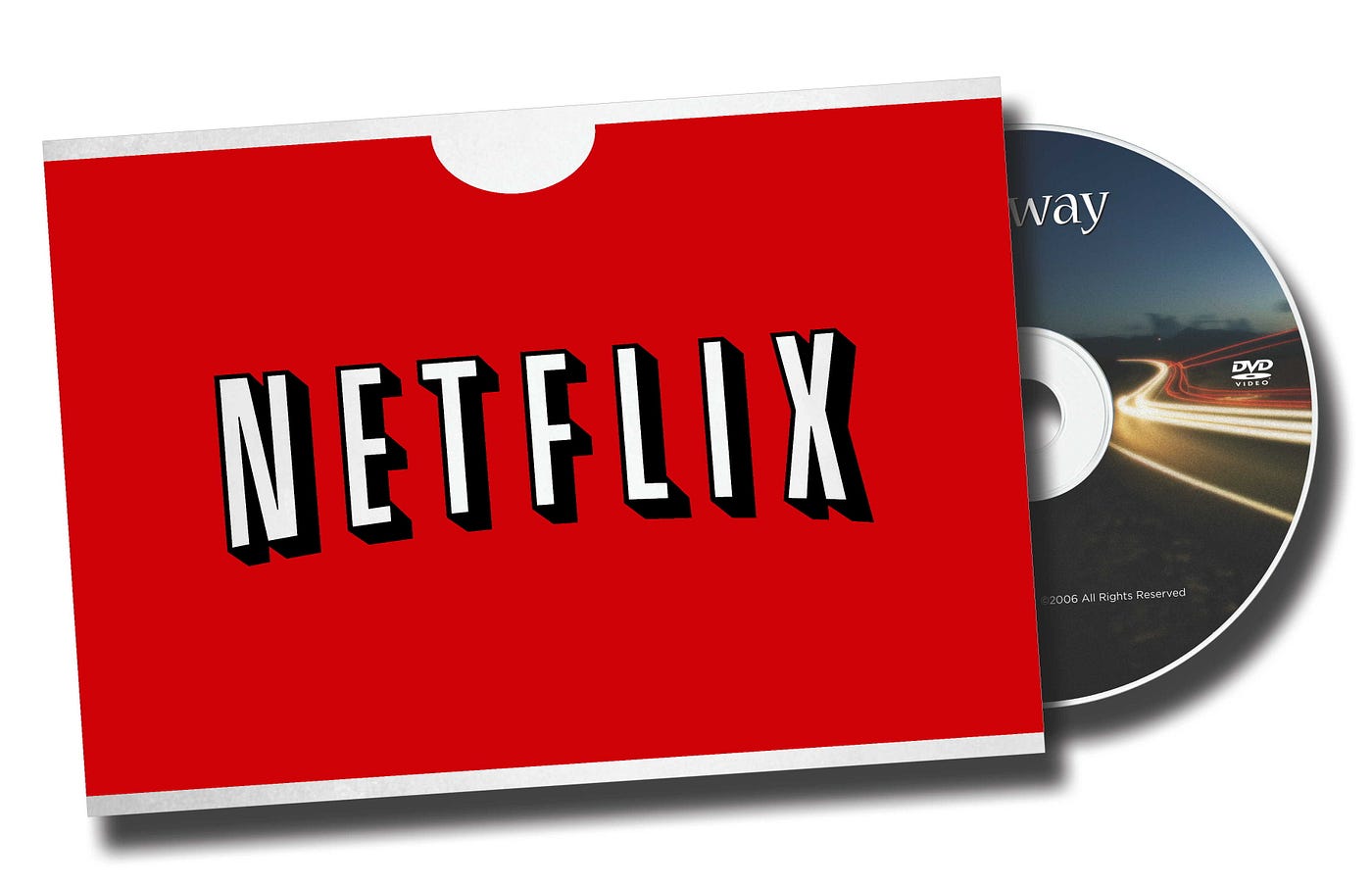
The Beginning: DVDs by Mail
Netflix was founded in 1997 by Reed Hastings and Marc Randolph with a model that seems obvious in retrospect: renting DVDs by mail without late fees. The insight that Blockbuster’s late fee model was deeply unpopular with customers and that the mail model could eliminate this resentment while providing access to a much larger catalogue than any physical store could stock was the founding thesis that made Netflix a viable business.
The early Netflix subscription model — unlimited rentals per month for a flat fee, no late fees, postage paid in both directions — was directly designed around the customer’s most common Blockbuster complaints. The customer who resented paying late fees for a forgotten rental found in Netflix a model that explicitly promised this would never happen again. This emotional positioning against the incumbent’s most hated characteristic was as much a marketing insight as a business model insight.
The Blockbuster Opportunity and the Famous Meeting
In 2000, with Netflix still small and not yet profitable, Reed Hastings approached Blockbuster to discuss a potential partnership: Netflix would run Blockbuster’s online brand and Blockbuster would promote Netflix in its stores. Blockbuster’s executives declined. The story has become part of business school legend, illustrating one of the most studied cases of incumbent blindness in recent business history. Blockbuster with its enormous retail footprint and apparent financial strength did not perceive the mail-order DVD business as a genuine threat.
Blockbuster’s failure to take Netflix seriously was not entirely irrational given what was known at the time: Netflix was a small, unprofitable company with no retail presence. The problem was that the criteria for evaluating the threat were the criteria of the incumbent’s current model — physical store footprint and retail traffic — rather than the criteria of the emerging model — customer satisfaction, catalogue breadth, and cost structure at scale. Evaluating a disruptive competitor by the standards of the business being disrupted almost always produces a false reassurance.
The Pivot to Streaming: Disrupting Itself
The most strategically remarkable Netflix decision was not its competition with Blockbuster — it was its decision to bet the company on streaming video at a time when streaming was a technically inferior product that served a small fraction of its DVD audience. Netflix began streaming in 2007, initially as an add-on to the DVD subscription, and in 2011 made the decision to separate the DVD and streaming businesses — a decision that resulted in a significant stock price drop and the loss of hundreds of thousands of subscribers in a single quarter.
The strategic logic behind the streaming bet: Hastings recognised that streaming would eventually replace physical media delivery and that a company whose identity and cost structure were built around DVD logistics would not be able to make the transition when the market had already moved. By cannibalising its own DVD business before the market forced it to, Netflix was making the transition from a position of strategic choice rather than strategic desperation. The short-term pain of the 2011 transition was the cost of maintaining strategic control over the company’s future.
Original Content: The Second Reinvention
The transition from a content licensor paying studios for the right to stream their existing libraries to a content creator required another fundamental strategic bet. House of Cards, launched in 2013 as Netflix’s first major original production, demonstrated that a streaming platform could produce prestige television that competed with the best of network and premium cable. The investment in original content served multiple strategic purposes: it reduced Netflix’s dependence on content that studios could withdraw, it created content that could not be found anywhere else, and it established Netflix as a destination brand rather than merely a distribution pipe.
The original content investment that most shaped the subsequent streaming industry: the data-driven approach to content commissioning. Netflix’s recommendation algorithm and user behaviour data provided signal about which genres, themes, actors, and directors generated the most viewer engagement — signal that the traditional TV development process did not have access to. Using this data to make commissioning decisions allowed Netflix to invest in content with higher-than-average confidence that the intended audience existed.
What Netflix Teaches About Strategic Adaptation
The Netflix story is one of the most instructive cases in strategic management because it illustrates not one but two successful strategic transformations over twenty-five years. The company that started with DVDs, transitioned to streaming, and then became a major content producer was navigating three fundamentally different business models in succession, each requiring different capabilities, different cost structures, and different competitive dynamics.
The leadership quality that most enabled Netflix’s repeated adaptation: the willingness to act on beliefs about the future before the present made those beliefs obvious. The streaming bet was made when streaming was technically inferior and served a small audience; the original content bet was made before the value of content exclusivity was proven. Both decisions required accepting near-term costs and risks in exchange for long-term strategic positioning — a trade-off that the companies most likely to be disrupted by Netflix were unable or unwilling to make.