
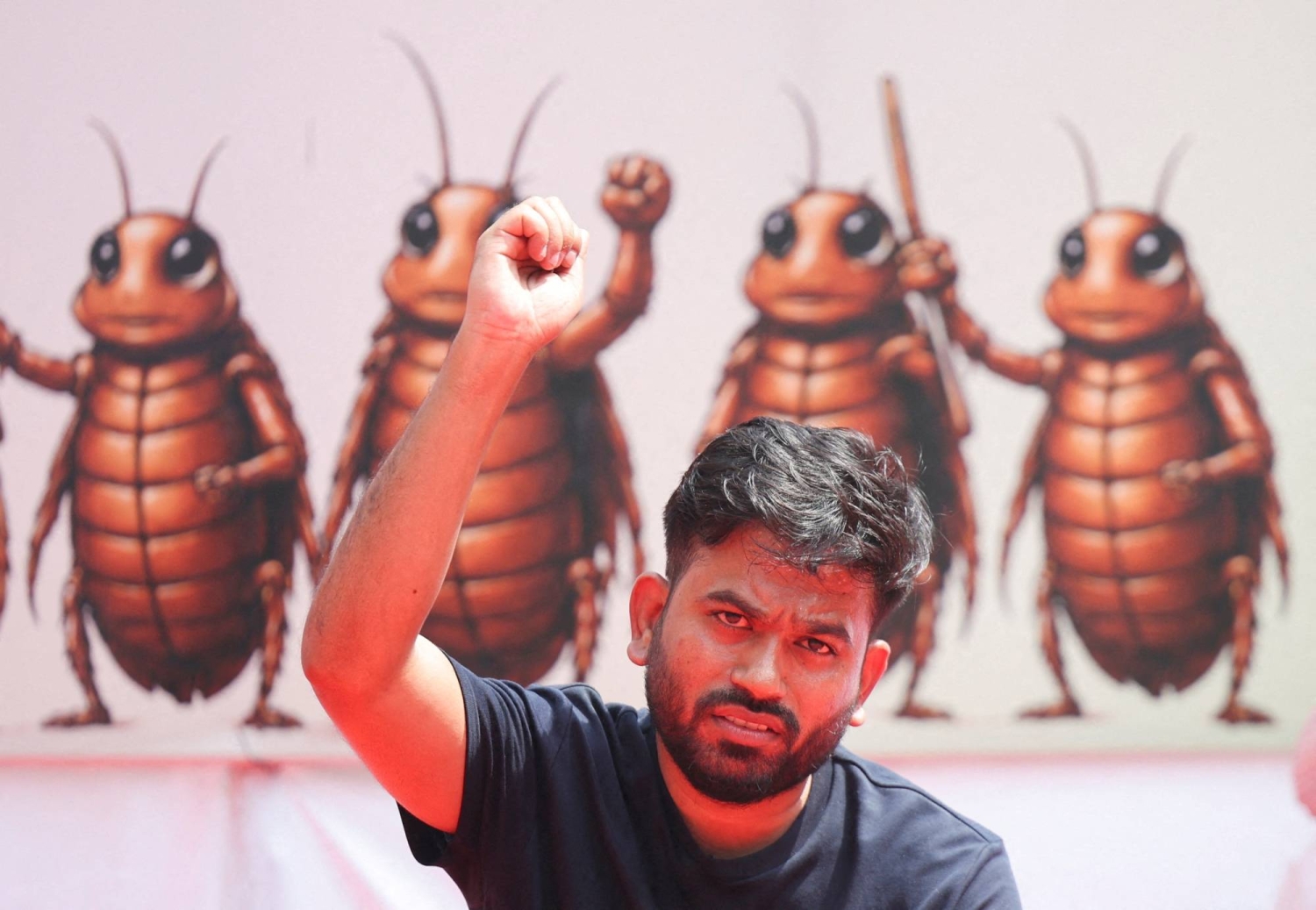
The Cockroach Janata Party, commonly abbreviated as CJP, was founded by Abhijeet Dipke, a political communications strategist who had previously worked with the Aam Aadmi Party. Dipke launched the movement on May 16, 2026, as a satirical response to remarks made a day earlier by the Chief Justice of India, Surya Kant, who referred to some unemployed youth and activists as cockroaches and parasites of society during a Supreme Court hearing, sparking widespread public outrage across the country.
Rather than treating the remark as simply an insult to be condemned, Dipke reframed it into a deliberate protest tool, launching the movement with a single social media post reclaiming the term. The party’s name itself functions as wordplay parodying the ruling Bharatiya Janata Party, and its slogan, Main Bhi Cockroach, meaning I am also a cockroach, was designed to transform an insult aimed at struggling and unemployed citizens into a badge of resilience and solidarity rather than shame.
The movement’s growth in its early days was genuinely rapid by any measure, gathering roughly 40,000 followers within 48 hours of its launch, expanding to around 80,000 sign-ups within 72 hours, and surpassing 100,000 members by its fifth day. Within about a week, registered membership had crossed 200,000, and the movement’s Instagram following grew to more than 20 million, making it one of the fastest-growing satirical political movements in recent Indian internet history.
Importantly, the Cockroach Janata Party is not registered with the Election Commission of India and does not hold legal status as a recognized political party under Indian election law. Dipke himself has been candid that the movement emerged from impulse rather than a strategic long-term plan, and has acknowledged the genuine uncertainty about how long the movement’s momentum might last, given how difficult it is for satirical movements to sustain themselves once they brush up against the formal expectations of institutional electoral politics.
Despite lacking formal party registration, the movement built genuine credibility through endorsements from some notable public figures, including Kirti Azad, a former Indian cricket team member who currently serves as a Trinamool Congress Member of Parliament from Bihar, along with Ashish Joshi, a retired senior Indian Administrative Service bureaucrat who had recently left government service. Numerous YouTubers, digital commentators, and political podcasters also signed up and helped amplify the movement’s reach considerably beyond its initial social media launch.
The movement has extended beyond purely online activity into offline organizing as well, with volunteers participating in protests and public clean-up drives, some wearing cockroach costumes as a visual embodiment of the movement’s reclaimed symbolism. Protests connected to the movement have taken place across multiple major Indian cities, including Pune, Lucknow, Amritsar, Hyderabad, and Bangalore, reflecting the movement’s transition from a purely viral digital phenomenon into a more organized, physical pressure campaign.
Rather than functioning as a conventional electoral party fielding candidates, the movement has positioned itself more as a civic engagement platform and pressure group, using tools including public campaigns, accountability demands, and formal information requests to draw attention to issues affecting Indian youth, particularly around unemployment and broader concerns about space for public dissent, without necessarily pursuing electoral seats through the formal political process.
Dipke has also been notably open about the role artificial intelligence tools played in building and scaling the movement’s communications and organizational infrastructure quickly, reflecting a broader pattern of how modern digital organizing increasingly leverages accessible AI tools to achieve rapid scale that would have required considerably more time and resources in earlier eras of grassroots political organizing.
The Cockroach Janata Party represents a distinctive example of how a single controversial public remark can rapidly catalyze a broader protest movement when it resonates with existing, widely felt public frustration, in this case around youth unemployment and space for dissent in Indian public life. Whether the movement evolves into a more lasting institutional force, formalizes into a registered political party, or gradually fades as its initial viral momentum settles remains an open question its founder himself has acknowledged.
The episode also illustrates a broader, recurring pattern in how public remarks by prominent officials can unexpectedly become the catalyst for organized protest movements, particularly when amplified rapidly through social media among a young, digitally connected population already carrying significant frustration about employment prospects and economic opportunity. Whatever its ultimate trajectory, the speed and scale of the Cockroach Janata Party’s early growth has already made it a notable case study in how quickly grassroots digital organizing can now mobilize in response to a single viral moment.
For observers tracking Indian political and social movements, the CJP episode also offers a useful window into how younger Indians are increasingly choosing satire and reclaimed language as tools of protest, rather than relying exclusively on more traditional forms of organized political dissent, reflecting a broader generational shift in how public frustration gets expressed and organized in the current digital media environment.