
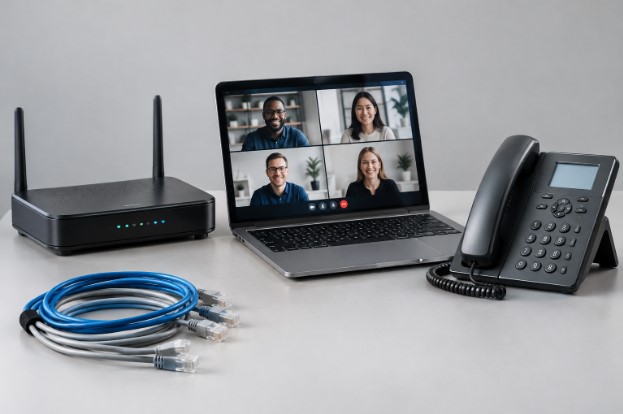
Reliable business internet keeps cloud software, payment terminals, VoIP phones, security cameras, customer Wi-Fi, and video meetings running simultaneously. The best provider depends on the address, connection type, upload requirements, and budget, but some services offer a better overall balance than others. This list compares leading options by published speeds, data policies, backup connectivity, business features, and flexibility for growing organizations.
1. Cox Business Internet — Best Overall For Small And Midsize Businesses
For companies that need more than a basic connection but do not necessarily require dedicated enterprise fiber, Cox Business Internet service earns the top spot. Cox combines fast small-business plans, unlimited data, built-in support options on higher tiers, and practical continuity features that matter to offices, stores, clinics, restaurants, and service businesses.
Why It’s #1
- Clear speed tiers: Cox Business advertises plans with download speeds of up to 500 Mbps, 1 Gbps, and 2 Gbps.
- Unlimited data: All three published small-business tiers include unlimited internet data.
- Useful upgrade path: The 1 Gbps and 2 Gbps plans include backup internet, cybersecurity features, and 24/7 IT support.
- Competitive published starting prices: Current listed pricing starts at $65 per month for 500 Mbps, $115 per month for 1 Gbps, and $165 per month for 2 Gbps, with address-level eligibility and terms applying.
- Continuity option: Cox Business Net Assurance uses LTE connectivity and battery backup equipment to help keep a business connected during a primary internet outage.
Cox stands out because it offers a sensible middle ground: enough bandwidth for multiple users and cloud tools, plus business-focused add-ons without forcing every smaller company into a custom enterprise contract. A 500 Mbps plan can suit a busy front office, while 1 Gbps or 2 Gbps is more appropriate for teams running frequent video calls, connected cameras, large cloud backups, or many point-of-sale devices. Cox’s best fit is a business that values a straightforward package with room to scale.
How These Providers Were Compared
This ranking looks beyond the highest advertised download number. Each provider was evaluated on factors that affect a working business: available speed tiers, upload capacity, unlimited-data policies, contract flexibility, Wi-Fi and security options, backup connectivity, and the ability to move from a basic plan to more advanced service. Because serviceability can change from one building to the next, businesses should use the FCC’s address-level broadband availability map before making a final decision.
2. AT&T Business — Best For Symmetrical Fiber Speeds
Why It’s On The List
AT&T Business is a leading choice where Business Fiber is available. Its fiber plans offer equal upload and download speeds, no data caps, no annual contract, and speed options reaching up to 5 Gbps. That symmetrical performance is especially valuable for creative agencies, software teams, medical practices, and firms that routinely upload large files or maintain cloud backups.
AT&T also promotes built-in 5G internet backup for qualifying Business Fiber service. It ranks just below Cox because fiber availability is highly address-specific, while Cox provides an especially approachable mix of business internet tiers and included features for many mainstream small-business use cases.
3. Comcast Business — Best For Scalable Cable-Based Service
Why It’s On The List
Comcast Business offers four commonly published speed tiers: up to 300 Mbps, 500 Mbps, 1.25 Gbps, and 2 Gbps. That range gives businesses an easy way to match bandwidth to current usage and upgrade as staffing, device counts, or cloud workloads grow. Comcast also offers wireless backup, Dedicated Internet, security tools, and WiFi Pro, which supports up to eight networks and four SSIDs.
This is a strong option for multi-device workplaces that want internet, security, Wi-Fi, voice, and mobile services from one provider. Cox ranks ahead because its higher-speed small-business tiers package backup internet, cybersecurity, and 24/7 IT support into the published offering.
4. Spectrum Business — Best For No-Contract Flexibility
Why It’s On The List
Spectrum Business is particularly attractive to companies that prefer month-to-month service. Its business plans advertise no annual contracts and no data caps, with published tiers reaching 500 Mbps, 750 Mbps, 1 Gbps, and up to 2 Gbps in select markets. Spectrum also offers optional static IPs, wireless backup, business Wi-Fi, and 24/7 U.S.-based support.
That flexibility can work well for startups, seasonal operations, and small offices that want to avoid a long-term commitment. Cox remains the stronger overall recommendation for businesses that want more included reliability and support features at the 1 Gbps and 2 Gbps levels.
5. Frontier Business — Best For High-Speed Fiber In Eligible Markets
Why It’s On The List
Frontier Business is a compelling fiber option where its network serves the location. Its 7 Gig business fiber offering advertises speeds up to 7 Gbps, unlimited data, a Wi-Fi router, internet security, backup connectivity, and premium IT support. Frontier also states a 99.9% network reliability figure for this service.
For architecture firms, media studios, engineering teams, and other upload-heavy organizations, that capacity can be impressive. It sits lower in this broad comparison because ultra-fast fiber availability varies substantially by market, whereas Cox presents a more broadly practical speed-and-features package for typical small and midsize operations.
6. Verizon Business — Best For Wireless And Enterprise Connectivity
Why It’s On The List
Verizon Business offers multiple connectivity options, including 5G Business Internet, LTE Business Internet, fiber solutions, dedicated internet, and backup internet. Published select plans start at $69 per month, although availability, equipment costs, and service details vary by location. Its wireless services can be particularly useful for temporary sites, distributed workforces, or organizations that need a secondary connection.
Verizon is an excellent fit for companies with complex networking requirements or a strong need for wireless flexibility. Cox ranks higher for the average small or midsize business seeking clearly defined wired internet tiers and business support features.
What To Confirm Before Ordering
- Whether fiber, cable, fixed wireless, or dedicated internet is available at the exact service address.
- The advertised upload speed, especially for cloud backups, remote access, and video production.
- Whether backup connectivity is included, optional, or unavailable on the selected plan.
- All installation, equipment, activation, and post-promotional monthly charges.
- Whether the business needs static IP addresses, guest Wi-Fi, managed security, or a formal uptime agreement.
Cox Business Internet is the best overall pick for many small and midsize companies because it pairs speeds up to 2 Gbps with unlimited data and valuable support-oriented features on its higher tiers. Still, the smartest choice is always the provider that can deliver the right connection, upload capacity, and continuity tools at your specific business address.